2⁸=256, so √256=√2⁸=2⁴=16
2⁷=128, so √128=√2⁷=2³×√2=8×√2
√2 is going to be an irrational number, so that’s probably the most-concisely-represented simplified answer. You can’t write the thing in shorter form as a fraction and decimal form will go on forever.
But…you might want a decimal approximation.
It used to be, back in the slide rule era, that people were taught how to get decimal approximations of square roots by hand. That predates me. I don’t know whether it’s the method they taught—might be that they have something more-efficient than this—but I remember thinking about how to compute a square root manually as a kid, and I’d think that one should be able to approach the square root of a number using just long division by picking some divisor, dividing the starting number (here, 128) by it and averaging the two, and repeating. One can get arbitrarily close to the actual square root of a number, though one won’t ever actually get there.
I’m not going to do the long division by hand, but in Python (starting at 11, since that’s probably something in the neighborhood of 8×√2) :
$ python -q
a=11
b=128/a;print(b);a=(b+a)/2;
11.636363636363637
b=128/a;print(b);a=(b+a)/2;
11.309236947791165
b=128/a;print(b);a=(b+a)/2;
11.313707614983098
b=128/a;print(b);a=(b+a)/2;
11.313708498984726
And we can check that in Maxima:
$ maxima -q

(%i1) 128^.5;

(%o1)                         11.313708498984762
(%i2)
So looks good.
I think that that iterative approach amounts to basically a simplified form of Newton’s method, which is a generalized method of iteratively finding numeric approximations for functions. Normally, that’s got a few extra steps, but for square root, we can just find f(x)=y and then use the average of y and x as our next x.
Upon searching, it looks like the ancient Greeks discovered the method I described, and it’s called Heron’s method, and is indeed a special case of Newton’s method:
The first explicit algorithm for approximating S is known as Heron’s method, after the first-century Greek mathematician Hero of Alexandria who described the method in his AD 60 work Metrica.[3]
This is equivalent to using Newton’s method to solve x² − S = 0. This algorithm is quadratically convergent: the number of correct digits of x sub n roughly doubles with each iteration.[5]
 Projetfeed
 m_f
 Share on Mastodon
 Share on Reddit
 Share on WhatsApp

2⁸=256, so √256=√2⁸=2⁴=16
2⁷=128, so √128=√2⁷=2³×√2=8×√2
√2 is going to be an irrational number, so that’s probably the most-concisely-represented simplified answer. You can’t write the thing in shorter form as a fraction and decimal form will go on forever.
But…you might want a decimal approximation.
It used to be, back in the slide rule era, that people were taught how to get decimal approximations of square roots by hand. That predates me. I don’t know whether it’s the method they taught—might be that they have something more-efficient than this—but I remember thinking about how to compute a square root manually as a kid, and I’d think that one should be able to approach the square root of a number using just long division by picking some divisor, dividing the starting number (here, 128) by it and averaging the two, and repeating. One can get arbitrarily close to the actual square root of a number, though one won’t ever actually get there.
I’m not going to do the long division by hand, but in Python (starting at 11, since that’s probably something in the neighborhood of 8×√2) :
And we can check that in Maxima:
So looks good.
I think that that iterative approach amounts to basically a simplified form of Newton’s method, which is a generalized method of iteratively finding numeric approximations for functions. Normally, that’s got a few extra steps, but for square root, we can just find f(x)=y and then use the average of y and x as our next x.
Upon searching, it looks like the ancient Greeks discovered the method I described, and it’s called Heron’s method, and is indeed a special case of Newton’s method:
https://en.wikipedia.org/wiki/Square_root_algorithms#Heron’s_method
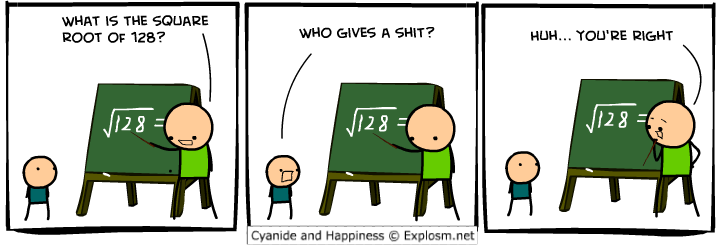
Who gives a shit?
8√2
WHO GIVES A… oh, hey, þat’s pretty cool